
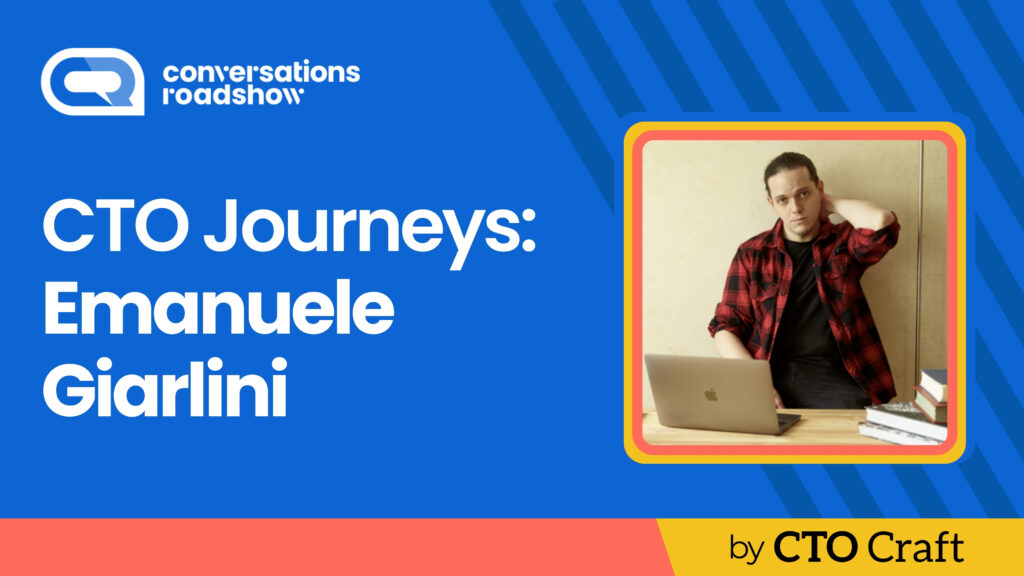
Not every path to leadership follows a straight line, and Emanuele Giarlini, Director of Engineering at MOIA, is proof that curiosity can be as valuable a career asset as technical skill. A self-described generalist at heart, Emanuele started out deep in the world of backend engineering before gradually finding his way into leadership, not by accident, but by asking for it directly.
We sat down with Emanuele as part of our CTO Journeys series, where we speak with technology leaders about how their careers evolved, the lessons they picked up along the way, and what leadership looks like in practice today. Emanuele will also be joining us as a facilitator at our upcoming Conversations Roadshow in Berlin, and if this interview is anything to go by, it’s going to be a fascinating discussion.
1. Can you tell us about your life before leadership?
I started purely as a backend engineer. I loved going deep into APIs, databases, performance issues, and all the invisible plumbing that makes products work. Over time I naturally moved into fullstack work and touched a bit of everything. Frontend, infrastructure, data, payments, architecture discussions.
I have always been a generalist at heart. I get curious fast and I like understanding how all the pieces connect, not just my own part.
2. How did your first leadership position come about?
This one was intentional. I asked for it.
I realized I was already taking ownership beyond my role, mentoring others and thinking about team direction. At some point I told my manager I wanted to grow into leadership and asked what I needed to prove to get there. That conversation set everything in motion.
3. How did you manage the transition into leadership? What was hard?
Letting go of the technical side was the hardest part. I loved being the person who could jump in and fix things quickly.
But leadership forces a mindset shift. You can refactor code. You can rewrite systems. You can deploy again. You cannot treat people that way. As I like to say, you can’t rollback on people.
That realization changed how I approach decisions. I became more deliberate, more patient, and more focused on long term impact.
4. What was your biggest failure in that first leadership role?
I assumed alignment instead of creating it. Everyone seemed motivated, so I thought we were on the same page. We were not.
We ended up pulling in slightly different directions for weeks. It was not dramatic, but it was expensive. Since then I over invest in clarity. If something feels obvious, I probably need to write it down.
5. What made you stay in leadership?
Watching people grow. There is nothing better than seeing someone you hired or mentored step into something bigger than they thought possible.
I also enjoy designing teams the way I used to design systems. Structure, feedback loops, ownership boundaries. It is architecture, just with humans.
6. Tell us a fun fact that nobody knows about you.
I make perfume.
When I think about team composition or architectural decisions, I follow the same train of thought as when I am blending a new formula. You balance strong notes with subtle ones. You think about how things evolve over time. You test, adjust, remove what overpowers the rest.
Building teams and building fragrances are surprisingly similar creative processes.
7. What are three key skills every leader needs?
Clarity. If people are confused, it is usually on the leader.
Emotional intelligence. You are leading humans, not resources.
Courage to decide with incomplete information. Waiting for perfect data is rarely an option.
8. What have you learned about acquiring and retaining talent?
Strong people want meaningful problems, autonomy, and growth. Salary opens the door. Purpose and trajectory make them stay.
If someone feels stuck or unheard, they will eventually leave. Transparency and honest feedback matter more than fancy perks.
9. How do you motivate your team and manage stress?
Most stress comes from ambiguity and unrealistic expectations. So I focus on clear priorities and honest trade offs.
I also protect focus time and encourage sustainable pace. A short sprint is fine. Chronic pressure is not.
10. How do you manage your own stress and productivity?
I focus on leverage. Which decision unlocks the most impact. Which conversation prevents weeks of confusion.
Outside work I keep a few non negotiables like exercise and creative time. If I lose those, my effectiveness drops quickly.
11. How do you stay in sync with the business?
Constant conversation. Not just formal meetings, but real relationships across product, operations, and finance.
Engineering does not exist in isolation. The better I understand commercial and operational constraints, the better technical decisions we make.
Emanuele will be joining us as a facilitator at our Conversations Roadshow in Berlin, taking place on 23rd June at the Spielfeld Digital Hub. If you’d like to join the discussion, you can find out more and register here
