
What is a senior engineer in 2028?
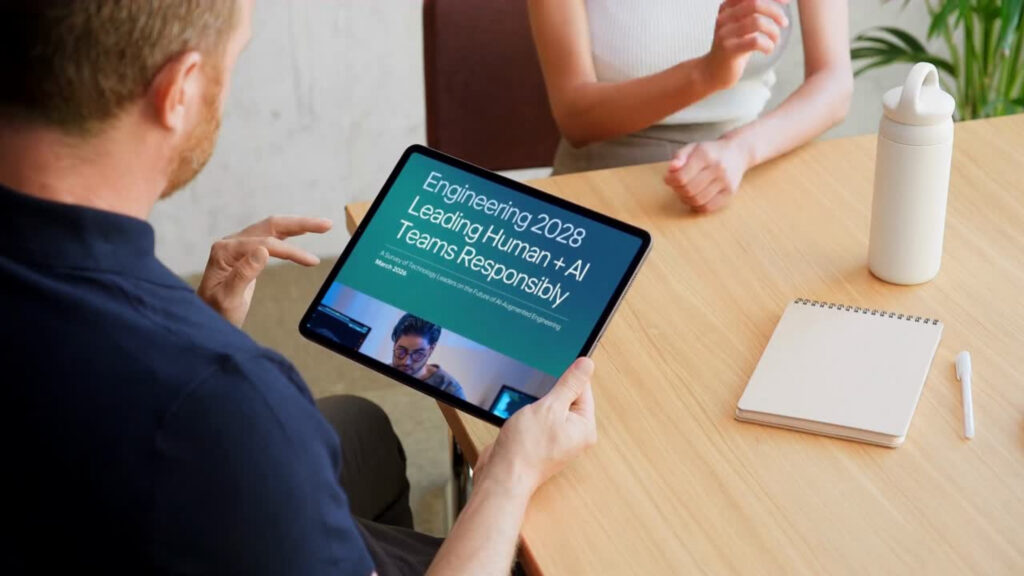
Engineering 2028: Leading Human + AI Teams Responsibly, produced in partnership with Damilah, put that question to senior technology leaders, and the answers suggest the ground is shifting faster than most organisations have noticed.
Since the beginning, seniority in engineering has meant one thing above all else: technical execution. The ability to write clean and efficient code, move through a Jira backlog with speed and precision, and be the person the team turns to when the problem is hard. That definition is changing as the nature of the work itself is now evolving.
From Syntax to Intent
As AI tooling takes on more of the work of code generation, the scarce and valuable contribution of an engineer moves upstream. Knowing why a system should be built a certain way, and being able to articulate that clearly enough to guide both human colleagues and AI tools, is where the premium is shifting to.
Data from our report reflects this. When respondents were asked which skills would define a high-performing team in 2028, the top four clustered tightly between 66% and 69%: AI fluency, domain and commercial understanding, human creativity and curiosity, and multi-disciplinary collaboration. Pure technical execution didn’t make the cut.
“Soft skills are going to become even more important… people are going to have to become articulate enough and open enough to share their learnings. Otherwise, AI will not be able to grow.”
– Abhishek Patel, CTO, BPX
The quality of human input going into a delivery pipeline, the clarity of intent, the depth of domain understanding, and the ability to communicate what ‘good’ actually looks like, is what determines how much value AI can add.
The Orchestrator Paradigm
The role emerging from this shift has a shape that’s becoming clearer across the organisations furthest into their AI adoption. Rather than using a single tool for a single task, engineers are increasingly managing ecosystems of specialised agents, configuring them, constraining them, and coordinating their output toward a specific and defined outcome.
“We’re going to be the agentic orchestrators. We’re going to orchestrate the agents to do the work for us.”
– Giorgos Ampavis, Technology Leader & Advisor
This is a meaningful change in what the job actually involves day to day. Architectural thinking, strategic intent, and verifying that AI-generated code isn’t hiding problems under the surface are taking up the space that syntax once occupied. As our report anticipates, the AI Orchestrator may well become a formal role, someone who manages a mixed team of human talent and specialised AI agents rather than writing code line by line themselves.
Preference for human oversight in the data backs this up. 88% of respondents expect mixed or always-human-in-the-loop approaches by 2028, with fully autonomous AI remaining the exception rather than the goal. The human layer is being repositioned, with more weight placed on judgment and oversight than on creation.
Where the Seniority Crisis Bites
Many engineers who’ve built long careers on coding proficiency have done so without needing to develop the skills now moving to the centre: communication, architectural thinking, business context, and the ability to write an RFC and defend a design decision in a room full of stakeholders.
A lot of senior engineers may not have honed those skills because they never had to. Technical execution carried them, and in an AI-first environment that’s no longer enough on its own.
“Seniority is no longer a safety net for those who refuse to lean into planning, architecture, and documentation.”
– Lee Provoost, CTO, Flagstone
Fortunately, that doesn’t mean those engineers are without options.
The institutional knowledge they carry, the domain understanding and familiarity with how and why systems were built the way they were, is precisely what’s needed to direct AI agents effectively. The question is whether they’re willing to reorient around it, and whether their organisations are creating the conditions for that pivot to happen.
What This Means for you
For engineering leaders, the implication is clear: hiring and development frameworks that treat coding proficiency as the primary metric are now optimising for the wrong outcome.
The engineers who’ll drive the most value by 2028 are those who can move fluidly between strategic intent and technical verification, who can hold the context of a system in their heads while managing the agents building it, and who can communicate clearly enough that both humans and AI tools understand what they’re trying to achieve. That profile looks different from what most job descriptions and performance frameworks currently reward, and identifying who on your current team already fits it, and who could develop in that direction with the right support, is a more useful planning exercise than debating headcount.
Our full Engineering 2028 Leading Human + Al Teams Responsibly report, created in partnership with Damilah, covers this issue and much more, including how senior leaders are thinking about headcount, AI adoption maturity, and the governance challenges that come with scaling human and AI teams together. You can download it here
Want to go deeper? We have two upcoming Bytes sessions diving even further into the findings of Engineering 2028: Leading Human + AI Teams Responsibly.
Our online Bytes session, The Maturity Roadmap: From Early Adoption to AI-Enabled Leadership, takes place on 23rd April and tackles the messy gap between AI experimentation and genuinely AI-enabled leadership, while our in-person Bytes, Engineering 2028: A Leadership Masterclass, takes place on 7th May in London and gets concrete about what mature human and AI orchestration actually looks like when teams move beyond the hype.
Both are free to attend and offer the chance to explore the findings in more depth and connect with peers who are navigating the same challenges.
